Sunday, June 12, 2011

A Few Good Heifers

Our little farm has grown some more as it was time to finally get some cattle. After waiting almost twelve months for the prices to come down, we gave up and decided to just buy some. We went to the Quoiba store cattle sale with very well defined objectives – anything except Black Angus. Almost all the cattle in the valley are either Friesian dairy cows or Black Angus and I just wanted something different. That way they will be easy to recognise if they get out. 
Quioba sale yards

We bought some cattle, sixteen Hereford heifers. Seven are twenty months old and ready to join and the rest are twelve to fourteen months old with a little growing still to do. They are all a little light in condition but we have plenty of feed to put them right. We got them at the Quoiba sale on Friday and unloaded them into the cattle yards just after dark that evening. Saturday morning we drenched them for worms and other parasites and back into a holding paddock, today they go out to their home paddock. In a month or two when they have gained some weight we will buy a Hereford Bull to put with them. In a couple of years we should have a nice little herd on the farm. The gestation of a cow is 285 days so nothing is going to happen in a hurry. 
Some of our Cattle waiting for the frost to lift.

Just hangin around.

Thursday, May 26, 2011

Where have all the windmills gone.

I am now after a windmill and high tank to replace the electric pump on the Leven River that supplies the house and troughs with water. Wind is the greatest natural source of energy and it is freely available day and night. No level of government has yet worked out how to charge for the wind, though I have no doubt they would if they could only work out how.
A farm should always have a windmill but here in Tasmania they are about as common as hens teeth.

At Varna we had three windmills, pumping water in an endless cycle. All windmills, regardless of brand shared some common endearing features. The wooden platform just below the head rots after about ten years exposure to the sun and rain and is never replaced. To stand on an old platform is to court a speedy and somewhat painful descent however the narrow iron supports can always be relied on to safely bear your weight. The top five feet of the tower is always greasy and treacherously slippery from the slow oil leaks accumulated over decades of use.

Jimmys Bore
Jimmys Bore had a 21 foot Southern Cross standing on a 50 foot three legged tower. This pumped up water from 400 feet underground for stock. Every six months Michelle and I had to pull the twenty lengths of 4 inch casing to remove the hard white sodic deposits that would slowly choke the pump.    


Salty Bore
Salty Bore had a 20foot D pattern Comet on a 45 foot four legged tower. The water in this bore was so salty it was of marginal value. Stock would drink it but only if they had no other option.


House mill.
The house had a 12 foot mill on a 25 foot tower that pumped water from the dam up to the high tank that supplied the house. It almost looked like any other 12 foot C pattern Comet but the name “Sidney Williams and Company” proudly cast in iron revealed its age. It had stood on the dam bank since some time prior to 1912 and is likely to be there yet, still reliably pumping water as it has done for all the past century. Sidney Williams produced windmills from1879 in Rockhampton under the Sidney Williams & Company brand, only introduced the famous Comet name in 1912. These are simple, reliable, direct action mills running in Spotted Gum bearings. If the oil pot is topped up every couple of years and the wicks replaced every ten or twenty years, the wooden bearings last indefinitely. The C and D pattern Comets are still in production, a design almost unchanged in over a hundred years. Workplace health and safety requirements have led to a metal platform replacing the wooden one, ladder platforms, and other changes to the tower to try to make them idiot proof.

A completely pointless exercise.

One of the immutable laws of physics tell us that if you make something idiot proof the only certain outcome is a  bigger idiot. The safest person up a windmill is a frightened one. Completely bloody useless but perfectly safe. With both legs and both arms wrapped through the tower, you would need a crowbar to prise them loose.

Windmills are an inseparable part of the heritage of the bush. They are a tangible link between the past and the future where windmills will continue to pump water through this century and the next.

Thursday, May 12, 2011

As Winter Draws Near

A frosty early morning.

Yep a bit cold.


Yep it’s definitely getting colder. Well so it should be it’s only six weeks until the Winter Solstice. Ah yes the shortest day of the year. After that’s over every day is just that bit longer again. The nights have been quiet cold especially those clear no cloud nights we’ve been having lately. These nights are fantastic star watching nights if you can stand being in the cold outside while the steam rises out of your nose and mouth. So many stars to see in the sky down here in Tassie and the Milky Way is just extraordinary. No light pollution in this clear no smog sky. The moon is waxing beautifully and is at its half way stage.

My front garden wearing a coat of white.
We are only 11 days into May and we’ve had five frosts so far and two very heavy ones, with everything facing south and in the shade still very white at 10 am. These are just a taste of more to come as we roll on into Winter. I do love the distinct change of Seasons down here. It’s such a nice change from the humdrum of the same; never vary much (only gets hotter and more humid) temperatures in North Queensland. The Autumn display of trees has been beautiful. Wherever I drive it’s a feast for the eyes, all those tones of red, copper and yellow.

I wonder how the animals like the colder nights. They are being babied with nice fresh dry hay on their beds to snuggle up into. The pigs still sleep three in a row like they use to when they were piglets, they’re so cute to watch. The chooks have finally learnt to roost I still have a bed of hay in there just in case they want to lie on it. We have two hens laying now the others can’t be all that far behind. One lays in a nesting box and the other one has a spot in the long grass where she’s made a nice little nest. Thank goodness she lays in the same spot every time. The Geese still go in to their pen at night to sleep on their nice bed of hay. We have fifteen now after we picked up two females from Deloraine way. So there you have a bunch of nicely spoilt animals. I’m sure they appreciate it.

As for us keeping warm, well we are waiting on our wood stove to come from the UK. It will warm up the kitchen and dinning area and we are putting in a wood heater to warm up the lounge and office area of the house. Nothing like a roaring fire to keep you warm. John and I use to sit in front of the old wood stove we had on “Varna” of a Winters night and we would read a book or I would knit. We didn’t have TV that far out in the bush at that time, besides we only had 32volt power. Amazing what you can do without if you don’t have it. The heat from the stove warmed our poddy lambs and kangaroo as well. They loved standing right up near it to keep warm.
One of the chooks checking out the frost.

The garden isn’t doing much at this time of the year. Some of the bulbs have started to pop their heads up they’ll make a nice display in Spring. It’s time for the plants to take a rest and hide from the cold just like we will be doing on some of those very cold days and nights to come.

Michelle

Sunday, April 24, 2011

Find me if you can.

Find me if you can.

One of our Light Sussex chooks has started to lay, about 6 eggs a week. The rest shouldn't be too far behind. Initially she laid one a day in the nesting boxes but after a week or so the flow of eggs dried up. Yes, we had progressed from collecting the eggs to find the eggs if you can. She had made her own nest, well camouflaged in the long grass. 

Three eggs
The accommodation is just not up to standard.


We bought another pair of pilgrim goose. 
More for the gaggle

We now have four pilgrim females, five pilgrim ganders, three cross-bred females and a further three young  juvenile cross-bred ganders. The three young cross-bred ganders are destined for the pot someday. The plan was to have one for Easter dinner however he received a last minute reprieve. I had everything ready- almost. I had no trouble catching the gander, these are so quiet you can just pick them up, carried him over to the chopping block where the cleaver was waiting, and the gander just lay there obligingly, with his neck outstretched on the block. He was so peaceful and trusting I just couldn't do it. I must be getting soft, I grew up in an era where killing animals to eat was just one more routine job. These bloody geese are just too quiet.

Thursday, April 14, 2011

Apples aint just Apples

We have solved the mystery surrounding the varieties of the three large old overgrown apple trees in the garden.  The solution, like all good solutions, was simple, ask the man who planted them all those years ago. 

Cox’s Orange Pippin. 
This is my favourite, a smaller crisp apple with exceptional flavour at its best when picked fully ripe straight from the tree. This is widely regarded as the classic English apple, often regarded as the finest of all apples and remains unsurpassed for its richness and complexity of flavour. This is the benchmark against which all others are measured.
This winter we will definitely be planting some more Cox’s Orange Pippins.

Cox's Orange Pippin

 Mutsu
A native of Japan the Mutsu is a large golden apple with a crisp white flesh, good flavour, lots of juice and is one of a small number of varieties which really is dual purpose - both for eating fresh and cooking. This is my second preference after the Cox’s Orange Pippin. The Mutsu is highly susceptible to the disease Blister Spot. The disease is caused by a bacterium that thrives in a wet cool summer- just like we have had. About 70% of the apples have the characteristic black rotting spots so these go straight to the pigs.
Our Mutsu is such a prolific bearer, even the possums can’t seem to make much impression.   


Mutsu


And last of all is a Red Delicious. Quite a nice apple eaten straight off the tree, it is probably the least suited to the home garden as its fruit all seem to ripen at the same time.
This is in contrast to the Mutsu and the Cox’s Orange Pippin, which continually ripen fruit over a 2-month period. 

Red Delicious


When eaten straight from the tree all of these apples are far superior to the supermarket varieties. It seems fresh really is best.

Tuesday, April 12, 2011

Rayburn Royal

We have ordered a Rayburn Royal slow combustion wood stove for the farm. I priced them locally and compared the retail price in the UK – huge difference. Thanks Gerry Harvey for pointing out how much cheaper it is to purchase from overseas.  I ordered one in British racing green straight from the UK.  I was talking to the supplier last night and it is due in Australia in 33 days. Allowing a couple of weeks to clear customs, we should have it installed before the dead of winter. This will also heat our hot water system so I am expecting a large reduction in the electricity bill.

The Rayburn Royal

I doubt anyone who has not lived year in –year out with only a wood stove in the kitchen can appreciate the difference between a well designed, well insulated slow combustion stove and the basic cast iron wood stoves that are still available today.

Our first experience with a wood stove was at Varna where we had a shining green enamel Crown Number 1 stove. This lightweight cast iron wood stove stood on four legs with a one and a half gallon hot water hopper on the side. It had little ability to control oven temperatures, a small firebox with a voracious appetite for wood and no insulation or firebricks at all.
On a 40°+  summer day the Crown Number 1 was guaranteed to turn any kitchen into a furnace from hell. The best that could be said for the early Crown stove was that it was marginally better than cooking on an open fire. Little did I realize when I threw it on the dump, within 25 years it would morph into a valuable antique.

We were lucky enough to replace it with a Wellstood slow combustion stove that was being removed from a house about 150 kilometres away.  The Wellstood was one of the best slow combustion wood stoves ever made. A classic example of 1950s Scottish craftsmanship, half a ton of fine-grained cast iron finished in glossy cream vitreous enamel. Well insulated, undoubtedly chock full of asbestos, a firebox fully lined with firebricks and clay mortar, simple to use controls and as a bonus, it fed a hot water system.
Good insulation and thermal mass are essential to a slow combustion stove, as much heat as possible is kept inside the stove, and half a ton of cast iron and firebricks helps maintain a consistent temperature in the oven.
We fed it on box and mulga; the box would happily burn away all night and the mulga provided lots of heat and little ash. It stayed alight for the best part of four years without ever going out.

There is something almost primeval about sitting in front of a slow combustion stove on a cold winters night, fire door open, basking in the warmth while watching the flames consume the timber. 
An ad for a Wellstood stove 1950s?


Thursday, March 31, 2011

Five Weeks Is A Bit Too Long

As I stand at my kitchen window and look out on another beautiful Autumn day here in Tasmania I watch a perfect jet stream in the bluest of skies. I’m wondering what the view is like this morning from the windows of this jet that’s sweeping above the best place in Australia to live.  I’m feeling a bit dreamy and poetic this morning.  I still can’t believe I live here and I’m not just on holiday like so many that pass by our farm with mainland number plates.

Hubby has been away for the last five weeks sweating it out in North Queensland. Every night when he rings he complains about the heat and humidity and wishes he was back home here enjoying the balmy weather. I know what he means I was glad to wave goodbye to the heat and humidity of North Queensland when we moved down here. I don’t miss it one bit.

Why we live where we live.
 I have been busy looking after our Menagerie while John is away.  I think he’ll see a real difference in how much they have grown in the time he’s been gone. The Pigs are getting longer and fatter. They still make me laugh with their antics they are funny to watch. The Chooks are bigger and have almost got their full combs. Barack the Rooster (no I didn’t name him after Barack Obama it’s because of the noise he makes) is a very big boy now with his very proud tail and comb. He is the quietest Rooster I have ever seen; normally I’m very wary of Roosters. I am still waiting for the Hens to lay.  Might have to stand the axe next to the door to give them some encouragement.  The Geese love their free-range life the Goslings have grown up and it’s hard to tell them apart now. Geese must be the messiest birds ever. I’ve never seen anything poo so much I really don’t enjoy cleaning out the Geese pen. It’s always the wettest and messiest pen. I think I’ll let John have that job when he gets back. The Chook pen is always dry and is easy to sweep out. As for the Pigs well they never poo in their pen. All in all the animals are enjoying their free- range lifestyle on our farm. I enjoy watching them do what I wish all animals could do and that’s wander around in the paddocks without a care in the world.

When John gets back we will have to get very serious about adding to our stock numbers. Oh well at least our paddocks are getting a good spell and regenerating the soil with all that nice growth of grass and pasture. I think the locals have been wondering why we have so much feed growing everywhere and why didn’t we cut and bail it when everyone else did. The land will thank us for not doing so in the long run. John comes back in a few days. Will be nice to talk to another human again. There’s only so much you can say to the Dogs, Pigs, Chooks and Geese. One way conversations are a bit boring. Yes five weeks is a bit too long when you've been used to the love of your life beside you sharing the ups and downs of life for the last 30 years.
Michelle

 Another beautiful view.

Wednesday, March 9, 2011

Autumn Is Here

A Frosty Morning

Ripening Nectarines
Well Autumn is here again and the days are slowly getting shorter. Plants in my flower garden are slowing down for the Winter. Soon the leaves will be putting on their beautiful Autumn foliage show. We were only 5 days into Autumn when I woke up to a big frost last week. The paddocks were white and beautiful in the early morning light. The day before we had a blast of Arctic Southerly wind. That night I thought no we won’t have a frost tonight so there’s no need to cover anything. But I was wrong. We didn’t loose much thank goodness only my Dahlias in the flower garden and the Fig Tree got hit a bit and so did the pumpkins and corn. All in all not too bad.

On the plus side the Apples are looking beautiful with their shiny new redness. The Pears are getting bigger and the Nectarines are now ripening nicely and they taste good too. There are a few of each on the ground of a morning as the Possums have a bit of a feed during the night. I don’t mind, as I love the wildlife coming into the garden.  From now on it will get cooler and cooler as we roll into Winter. Thank goodness we have our new wood stove on the way to us from the UK. Can’t wait to set that up and start cooking on it. It will keep us warm as well as provide us with hot water. This will be our first Tassie Winter here on the farm it will be interesting to see how we go.
Michelle
Rosey Red Apples
Yummy Pears

Thursday, February 24, 2011

As Happy As A Pig In Mud


A good spot to lie down.


Mud is good.
Prada looking a bit dirty.

As the saying goes “Happy as a pig in mud”.  The pigs love to cool off in the hot weather too and their favourite way is to wallow in a mud puddle. The definition in the dictionary of wallow is, to roll about with enjoyment; yep that’s what they do all right. I usually turn a hose on in the paddock to make their wallow area. As soon as they see me doing this they run up the paddock to investigate and then they are into it.  Sometimes Prada our Miniture Poodle decides to join in with the fun and of course she throws her ball into the middle of mud and pigs and water. She never goes anywhere without this ball. The pigs are on familiar terms with our dogs and don’t mind them at all. The more the pigs get excited in the mud the more Prada throws her ball in and the more she gets wet from the hose and muddy from the puddle.

Watching the pigs in the mud you can see how much they really enjoy it. Sometimes they put their head in and then just slide the rest of their body along until they are lying down.  Pigs don't really like the weather very hot, because they have very few sweat glands, actually they can hardly sweat at all. They are also not very good at getting rid of heat from their wet mucus membranes in the mouth by panting, as dogs do. When it comes down to it pigs are not very good at handling heat stress at all. The temperature where they are comfortable runs from 16 to 22°C. In commercial piggeries, when the temperature goes above this, water is dripped, sprayed or misted onto them, and fans are turned on to cool them down. Poor little darlings have no mud to wallow in. Our pigs are so lucky to be free range and have a whole paddock to run around in and a big mud puddle to wallow in. They are also lucky to have a warm and snug stable to go in and out of as they please with a big comfy bed of thick straw to lie down on.

Feeding time in the late afternoon is a sight to behold and the sounds that echo out are deafening. I always say it sounds like feeding time at the Zoo. The routine is to feed the pigs first because that gets them out of our way otherwise they get under foot. As soon as we arrive at the door of the stables they are there waiting and it’s a case of battling your way in past the pigs to get to the pig pellets to feed them. Once they are done (very quickly so they don’t knock you down trying to get to the scrap bucket and pellets) it’s on to the poultry. The chooks are first; they are no bother unless they get a bit too excited and go into the geese pen by mistake although that doesn’t happen much anymore.  Then we feed the geese, they are the noisiest by far the sound is very loud. I always think to myself I must record this so our friends can hear sounds of the afternoon animal symphony of pigs, chooks and geese with the occasional dog bark. They all sound like they are as happy as a pig in mud.

Michelle.

Monday, February 21, 2011

The Rhythm of Leven River Farm.

Platypus heaven


Life on Leven River Farm has settled into a comfortable rhythm, a rhythm set by the sun and the wind and the rain, a rhythm as old as time itself.
The corn is setting cobs, the pumpkins and the tomatoes are in flower, the autumn vegetables are bursting forth and the native animals come and go as they please.

The Leven River rises and falls with rainfall and along with supplying us with water provides a safe home to a family of platypus that can be spotted in the clear water some evenings.  They are smaller than I had imagined and not as timid as I had expected. They never seem to be in a hurry and just slowly swim away when disturbed.
 
In the late evening an Eastern Barred Bandicoot scurries busily around the garden digging for grubs and insects. It never ventures far from the hedge and beats a hurried retreat if disturbed. We can watch it come and go from the dining room window but it quickly disappears if the door opens.  

A solitary Devil sometimes visits late in the night, a well-mannered, occasionally noisy animal who ambles up the driveway and departs back down in his own good time. The sound of a devil in the night is unmistakable. We regularly see devils dead on the road on the way into town so I hope this chap can avoid becoming just another bit of road kill.

We saw a spotted-tailed quoll on the road coming back home late at night. This was a timely reminder on the need to lock up the chooks and geese at night. The spotted-tailed quoll is a capable hunter that, like the eastern quoll, kills its prey by biting on or behind the head. They love chooks and will reportedly keep returning night after night until they have wiped them out.  Adult geese are usually safe from quolls but any goslings can be quickly wiped out.

Thursday, February 17, 2011

More of the past. Jojo comes to stay.

Michelle feeding Jojo

About 18 months old. I'm a big girl now.

1986, the drought continued, outside work was scarce, and the bank manager was getting edgy about the overdraft. So when the going gets tough - the tough go roo shooting.
Roo shooting is a hard, soul destroying way to make a few quid, out all night shooting roos, skin them, trim, salt and tag the skins in the morning and then out again another night.
On one of these nocturnal forays Michelle rescued a joey, small hairless scrap of an animal a few inches long. I have no idea what was special about this one; I routinely dispatched a few joeys every night that we went shooting, but I knew better than to interfere. Sometimes a woman just has to do what woman has to do! She christened the joey “Jojo” and shooting was finished for the night as we returned home to try to keep this animal alive.
Personally I thought it was a lost cause because joeys are notoriously difficult to raise, and Jojo was way to small to be a good candidate.

Michelle kept her in a box beside the stove and every two hours fed her through a tiny piece of electrical wire insulation, a mixture of sunshine milk, egg and powered charcoal. It may seem like a strange mixture but Jojo thrived. She grew fur, graduated to a hessian bag with a slit in the front hanging beside the wood stove and learned to drink from a poddy lambs bottle. The heat from the wood stove kept her warm through the icy frosts of winter. She became Michelle’s little shadow, always following close behind, however at any strange noise Jojo would race flat out through the house to the kitchen and dive head first into her substitute pouch.
Having just got rid of the bloody roos living in the house, we had another one inside.

Jojo grew up surrounded by dogs and had absolutely no fear of them. If they got a bit boisterous she would bite them around the head. Kangaroos have sharp teeth and a few strange dogs learned the hard way, this was not a kangaroo to be trifled with. 

Saturday, February 12, 2011

The taste of summer.

In December it’s “I wish these cherries would ripen up” and “I hope all these birds are going to leave us some cherries.”
In January its:  Pick cherries, eat cherries and make cherry jam.
In February its “Let the chooks into the garden to clean up the bloody cherries”
The chooks look like they have been in a massacre, their head and beaks are stained a deep purple from the cherry juice.  Not satisfied with cherries they started pinching strawberries so out they went again. They now hang around the gate in the morning, just waiting to be let in.
 The apple trees in the garden are loaded with ripening fruit, but there are also plenty of wild apple trees around. This morning we raided one of the wild trees and collected fifty or sixty apples for the pigs. The tree was so loaded with fruit you couldn’t see where we had been.
 The blackberries have just started to ripen. I have never tasted fresh blackberries before so I never knew what I was missing, they are delicious. 
 Wild plum trees abound beside the roads and down the river. They are just about finished for this year, just a few trees left to raid. The fruit is small, dripping with juice and flavour. We stopped at a tree beside the road and picked six or seven kilograms of brilliant red and orange plums. The best plums I have ever tasted. Some we ate, the bulk became plum jam.
The nectarine tree is loaded with fruit; some branches have been dragged down to the ground level with the weight. They are large and plump but not yet ripe however their smell is divine.

Tuesday, February 8, 2011

The perils of beekeeping.

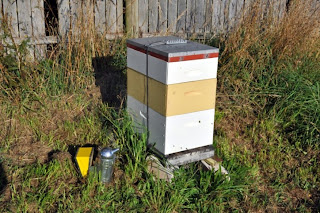
Hive and smoker


Making honey

 
We are now self-sufficient in honey as our two bee hives have completed their brood chambers and are now filling the supers, about one kilo of honey a week. The only drawback with bees is their sting can be lethal. Reportedly 243,522 people died in 2009 from bee stings. (No idea if this number is accurate. Just googled it)

I was fortunate to get some good advice from a beekeeper on how to avoid stings and this has to be true because beekeepers are related to fisherman and neither would ever lie.
So how does one protect oneself from bee stings?
  • The smoker. The smoke calms the hive down, keeps the bees docile and is the first line of defense. The smoker is the most reliable, dependable tool a beekeeper can have. It can be relied upon to sit beside you while you rob the hive; a continuous little stream of smoke curling from the spout showing it is lit and ready for action. But should you need the smoker to calm a few frayed nerves in the beehive you can depend on it to have gone out. Little anemic puffs of smoke and then nothing.

  • The bee suit. This is a fully enclosed suit perfectly designed to keep the bees out. Unfortunately it seems to be more successful at keeping bees inside the suit. Just a slight drawback.

  • Smell. Bees are incredibly sensitive to smell. They hate perfumes, deodorants, aftershave and the like with a passion. So if you are a sensitive caring new-aged metrosexual, beware, the bees will sniff you out and remember their sting can be lethal. 

  • The decoy. This is my favorite. Always have a helper when robbing the hive, preferably one who moves around a lot, talks a lot and can be relied upon to draw the angry bees away from you. Wives may seem like the obvious decoy but apparently they can only be used once as they usually turn out to be considerably more lethal than the bees.

The two hives have different personalities. One hive is extremely docile and calm, hardly reacting at all to the hive being opened. The other is notably more active, more aggressive and produces more honey. I am lucky; bees seem to take little notice of me, don’t sting me and I can handle the hives without upsetting them.

Monday, February 7, 2011

What happens when the Man of the house is away.

The Leven River.


Water may be the Giver of Life but at the moment it’s the Bane of mine. Every time John is away if there’s something that’s going to go wrong around the farm you can be sure it has something to do with water. The last couple of times it was the house water. We pump water from the river and a flood in the river moved and blocked up the foot valve on the pipe twice, leaving me with no water in the house (of course I didn’t know it was that at the time). Frantic phone call to Hubby “I don’t know what’s wrong there’s no water in the house”.  He calmly said “Well it’s probably Blah Blah Blah” and he was right. Thank goodness we had rainwater as well, so for the next couple of days I bathed in bucketed water from the rainwater tank and used lots of kettles of hot water. The next time he was away it happened again but this time before he went away he hooked up the rainwater to the house as well, just in case it happened again and all I had to do was turn a tap on and one off. Well that was easy.

Our beautiful Valley.
This time it’s water again. I went into the stables to do the nightly feed of the animals and what greeted me as I opened the door (apart from the pigs)? Yep you guessed it, water all over the floor and flooding the goose pen and the chook pen. Glad I wore my gumboots. Thankfully the pig pen was high and dry, one out of three aint bad.  We lock the poultry up at night just in case there’s a Quoll or Tassie Devil around. Right, where the heck is this water coming from? A check around and it’s the new waterer we put in for the chooks. It was spraying out everywhere. Here I am with an arm full of animal feed not knowing what to do first.  Let’s see, I’ll feed the pigs and get them out of the way first then race out and turn off the main tap on that line. That done I tackled the geese, putting grain in their feeders. Then on to the chooks, scattered their feed around and then realised whoops 2 chooks missing. Where are they? In with the geese of course so I had to try to get them out of there which was hard because they had discovered the geese grain. Got them out finally with a lot of coaxing and into their pen and locked the door.  Meanwhile, while I was doing that the pigs had discovered that I hadn’t shut the goose pen door properly and were happily in the pen eating the grain with the geese. Now this was fun trying to get 3 pigs out of a place where there was yummy food. As soon as I’d get one out the others wouldn’t move, then I got the other two out and the first one got back in again.  All the time trying not to open the door too far so the geese wouldn’t get out as well. I’d better run back up to the house for more pig food.  After a lot of swearing and coaxing with a new bucket of food I got the pigs out and locked the geese pen door. All safe and sound again, well apart from the flooded floor. Luckily the chooks had an island of dry straw to sleep on and as for the geese well I left the door to their pen open all night and crossed my fingers that they’d be safe the next morning.

Yep they were, when I woke up they were waddling their way down to the dam for a morning swim. They say never work with animals or children. Well I’ve worked with lots of children over the years and have never had this much of a problem. I must have looked hilarious racing around trying to put animals back into their right pens. A true comedy of errors, I’m sure water will be kind to me next time.   
Michelle.

Tuesday, February 1, 2011

More of the past, How to house train kangaroos and clumsy visitors.

The latest in kangaroo training equipment.

White ants and kangaroos had shared the Varna house for many years and neither were prepared to leave quietly. At night kangaroos would pop up into the house through white ant eaten holes in the floor. If they had kept quiet it would not have been so bad but they kept waking us up at night – They had to be house trained. The solution , like all good solutions was simple, effective and relied an the very latest in kangaroo training technology. I kept a pea rifle (a single shot .22 rifle for those that don't understand Australian english) and a handful of ratshot cartridges beside the bed. I could wake up, fire ratshot at the roos, drive them outside and go back to sleep without getting out of bed. Ratshot was ideal. It could do little more than sting the roos, there was no blood to clean up in the morning and the stray pellets would do no harm to the house. After three or four weeks the roos worked out that they were no longer welcome and departed to find a home of their own.

There is a common belief that white ants won’t eat cypress pine but someone forgot to tell that to the white ants at Varna. The termites found sections of the house that were to their liking and ate the lot leaving just the paint behind. The very fact the house was standing was testament to the strength and resilience of load bearing paint! We eventually packed large holes in the floor with layers of newspapers and covered the lot with a roll of dark green lino we found. Looked a lot better but still a no go zone for walking. It is amazing how quickly you learn to step over or around the holes, even half asleep in the dark. It just becomes an unconscious reflex. Visitors on the other hand proved to be a clumsy lot of bastards; seemingly hell bent on stepping into holes and tearing holes in the lino. Never did work out how to train them, obviously less intelligent than roos. 

To be continued ???????

Monday, January 31, 2011

More geese

A new pair.   
Found another breeding pair of Pilgrims. These are a really nice example of the breed and unrelated to our other pair. Word gets around that we are keeping Pilgrim geese and these were offered to us as their owners were moving to the mainland. Sometimes you can just get lucky.
We are taking a slightly different approach to commercial flock production with our geese breeding. Rather than run five geese to one gander, we going to let them remain in bonded pairs. Given the opportunity, geese mate for life and while total production per adult bird will decline, I believe it will be better for the welfare of our birds.
If commercial production was the dominant factor in selecting our geese breed, the Pilgrim wouldn’t even rate; their average egg production is only about 30 per year, poor hatching rates in an incubator and slower growth rates. However, left as pairs, they are excellent natural parents, are not aggressive, forage well and are supposed to be one of the best eating geese. Ideal for small scale free range production.

Saturday, January 29, 2011

The past

The past is important as it shapes the person we are today. Names and other details may be changed only to protect the guilty, for the innocent have no need for such protection.

Varna
In 1985 Michelle and I bought Varna, a 50,000-acre block of hard red mulga country in western Queensland. This was sheep country, a starvation block in all but the best years, but it was ours, and we were young, naive and full of enthusiasm. This was where Michelle and I were to start our family and battle the relentless drought and the just as relentless bank manager.
Our home for four years

 I still remember the house as I first saw it standing alone in the mulga. It had once been a grand old house but the endless passing of time had left their mark. The house been abandoned to the elements more than thirty years ago and kangaroos had taken up residence. White ants were slowly, steadly devouring the structure; both ends of the house were drooped towards the ground.

The previous occupants had left sometime in the nineteen fifties and appeared to have just walked out, never to return. Cups, plates, saucepans and cutlery still filled the kitchen cupboards. Oil lamps, the oil long since evaporated still stood ready to illuminate the night. The pantry was a treasure trove of long forgotten items. Egg glass, carbide, preserving salts, ornate bottles of Rosella chutney, caster oil, strychnine and patent livestock medicines shared space with piles of 1940s newspapers. The shed still held a Ford Mainline ute, resting on perished whitewall tires, keys in the ignition, waiting for the driver that never returned.
A womans work is never done.


There was no sign of a bathroom in the old house. Our first bathroom was a sheet of corrugated iron on the ground under a mulga tree. We would heat a bucket of water up on the stove and hoist it into the tree. That worked very well until the first chills of winter hit. Nothing like ice on the ground and a southerly wind to make an inside bathroom became a priority.

Beside the house stood the engine room. This was home to a 1930s vintage Southern Cross YB diesel driving a 32volt generator. Four and a half feet high, three quarters of a ton of black greasy raw brute power, all of 4 horsepower. It hadn’t run for thirty years but it still had dregs of fuel and when I filled the hopper with water and swung on the crank handle, it fired back into life- we had power. For the next four years the steady reliable beat of that remarkable old engine became the heartbeat of Varna.


In 1985 wool prices were low, interest rates had started their remorseless climb towards 20% and cattle were the only bright spot on the rural landscape. The only problem was, we didn’t have any, and so we decided to remedy this deficiency using the time-honored traditions of the bush. We would just help ourselves.
Varna joined the Mariala reserve, crown land that has since been turned into a National Park. There were some small mobs of cleanskin cattle living on the creek flats; the need was imperative, the opportunity was clear, the temptation was great.

Technically I suppose they belonged to the crown, but the Queen had never show any great interest in her cattle and besides our need was greater. We set of in the Suzuki Four wheel drive, myself, Michelle, a couple of dogs and a rifle, just in case. This was never going to be easy, but given the right conditions, a bit of luck and some hard driving, we were in with a chance. 
A steam engine we found in Mariala while looking for cattle.

As we followed one of the creek flats we came upon a small mob of cattle, about a dozen head of cows, a few calves, couple of mickys and a scrub bull; all cleanskins. All out in the open, we just had to keep them out of the scrub, our luck was in! The roan bull was a magnificent specimen of a scrub bull- all shoulders and neck with thick stubby horns about a foot long. In stud livestock terms, all horns and balls, but as a scrub bull, perfectly adapted to his environment.

We quietly eased the Suzuki around the cattle to point their heads towards home. At first the cattle took little notice however as we edged in closer the cows and calves started to feed out in the right direction, but that old bull stood his ground and never moved from the shade of the mulga tree. Quietly, slowly we eased in closer, not quick enough to make him run, trying to giving him time to get used to us and move of with his herd.

Instead, he launched himself at the vehicle, and he caught us flat footed. There was no way the Suzuki could outpace him in the short distance and he rammed one of his horns through the back of the cab on the Michelle’s side. Immediate acceleration. Blood and snot everywhere. The window glass disintegrated and rained as small glass cubes through the front of the vehicle. Michelle tried to sit on the gearstick which made driving just a little bit more difficult. I said “shoot him, shoot him” but she seemed more inclined to stay as far away from that bulls head as possible. Fifty metres or so later, the bull freed from the vehicle, trotted of to regain his herd that had disappeared into the shelter of the scrub.

We decided the Queen could keep her bloody cattle!
To be continued ???

Thursday, January 27, 2011

Wascally Wabbits


Bailey and Holly
Why have we got Rabbits you may ask, they don’t contribute anything to the farm.  Well it’s just because I always wanted a pet Rabbit when I was a child, so I’m fulfilling a childhood desire and they are so adorably cute as well. In Queensland it’s illegal to keep Rabbits so once we moved to Tassie I thought, why not have a pet Rabbit. Now to convince the better half it’s a good idea. Ummm…. Darling I thought of a really cool Christmas present we could get the kids (both grown up and in their early 20’s). Well any excuse will do won’t it?

 When our youngest Daughter flew down just before Christmas I told her about my idea and she thought it was great. The next day Jess and I went into Devonport to do some Christmas shopping and we just happened to go and look at the pet shop. Sitting in one of the cages were the most adorable pair of young Miniature Lop Eared Female Rabbits. Jess and I couldn’t contain ourselves we gooed and garred over them.  Anybody hearing us would’ve thought we were looking at a couple of babies. I told the lady in the shop we loved them but just had to convince Hubby it was a good idea. When we got home we worked on John, subtly of course.  It worked.

The next day into town we went to pick up a Rabbit Hutch (a two storey one so they have more room to run around in) and the Rabbits (which luckily were still there).  Then it was up to Jess and Fiona to name them. Jess called hers Bailey (because it’s the colour of Baileys Irish Cream) and Fiona called hers Holly (because it was near Christmas time).  Every now and then I let them run around inside for more exercise and don’t they love it.  They are curious little critters and like to check everything out. Prada our miniature Poodle thinks they are fun and likes to throw her ball to them. I’m convinced she thinks they are dogs she does the same thing to the pigs it’s hilarious to watch.

 Here’s a quick history of the Miniature Lop Rabbit. They can be traced back to the Netherlands during the late 1940’s when Adrian de Cook had a vision to produce a miniaturised version of the larger French Lop. He used a French Lop buck and a Netherlands Dwarf doe but it was unsuccessful the litter being born too large. In the second attempt a Netherlands Dwarf buck was crossed with a French lop doe it went well although the ears were all erect. Then one of the does was mated to an English Lop buck. The English Lop was chosen because it is a smaller size than the French Lop and it has very long lopped ears. This was very successful and all ears were floppy. Now for some interesting facts, did you know Rabbits need to eat their own droppings this enables them to digest even more nutrients. A shame mine don’t eat more, every morning there seems to be so much Rabbit poo for just two little Rabbits. A healthy and cared for Rabbit can live up to 10 years. You can toilet train Rabbits to use a litter tray (that I’d like to see). Rabbits can’t sweat so to regulate their body temperature they use their ears.

The Hutch
Michelle

Monday, January 24, 2011

Why Free Range


Wander through the grass
Root around

Fill up on pig pellets and fruit and have a good nights rest


                    Nothing more needs to be said!!!!!